Showing posts with label Nutrition. Show all posts

Thursday, February 23, 2012

A Chemist Walks into a Bar...


I crack myself up!


Number of days that I've been sugar free: 50

Mini update: So far so good as far as sticking to my resolution.  I haven't had a drop of wine...not a drop.  I haven't had a single cookie, chocolate, slice of cake...nothing sweet.    I was planning on making it to the end of February but since there's this thing that we Catholics call "Lent" happening right now, maybe I'll use that as an excuse and participate for once to keep this going. (My grandmother would be proud at least).

If you're wondering if I miss any of the foods I've given up my answer is NOPE!  First of all, the great thing about going cold turkey on the sweets is the less you eat them the less you crave them.  So no, I don't miss them.  I'll designate my birthday as a day of celebration and have sweets and alcohol then.  It's a ways off though.   But more importantly, I don't have time to suffer a hang over considering I have class all day Saturday, and Sunday's are dedicated long run days (for now because guess what starts next weekend.... SOCCER!!! Oh soccer, I've missed you so much. I knew I couldn't stay away all winter.  I started going to a weekly conditioning/skills camp to get ready for the season.  Always need to work on my touch with the ball and I definitely need to improve my sprints.)

Anyway, having no time seems to be a running theme with me lately, hence the lack of updates.  But all the free time I did have between semesters I now spend studying Molecular and Cellular Biology, which is another pre-requisite for the Dietetics degree I am working towards.

I've learned some neat stuff in class so far.  For example... you know when you feel that lactic acid burn when you work out but it goes away pretty quickly.  Well that's your bodies bicarbonate buffer system restoring your blood to it's normal pH levels (7.35-7.45--slightly acidic but that's the normal range).  Pretty neat how the body works to return to it's normal functioning levels very quickly isn't it?  That is called homeostasis.  All living organisms practice homeostasis.

Also, I've learned about the molecular structure of Carbohydrates, Lipids, Proteins and Nucleic Acid.  Proteins are really complicated and there's a lot more I will learn about them in the future.  Carbohydrates, naturally I was interested in learning about since they get a lot of bad rep.  They're a good source of quick energy which we already knew, but what are they made of?  These unanswered questions I've had are why I want to be a dietitian, I really want to know how all this works, how it breaks down in the body.


So back to Carbs, essentially they're made up of carbon, hydrogen and oxygen atoms (ratio 1:2:1). Carbo-Hydrate... Carbon and water, get it?  Deoxyribose a  component of DNA is actually a carbohydrate!  Who knew.  Anyway,  carbohydrates or saccharides are found as either monosaccharides, disaccharides, or polysaccharides.  A common example of a disaccharide is table sugar.  Sugar is made up of one monomer of glucose and a monomer of fructose (which is the sugar found in fruit).  Polysaccharides (ie your starches, rice wheat, root vegetables etc) are just made up of many glucose monomers so when you break them down it's simply breaking down into those smaller glucose monomers and as I stated above glucose is a sugar, which is why we need to portion our carbs (fruit and dairy included-lactose is a natural sugar found in milk) no matter how healthy we think it is!

Lipids (fats, waxes, steroids) are even better than carbohydrates for long term energy storage.  So get the idea that fat is evil out of your head.  Not all fats are created equal.  Lipids are essential to life.  They are the barriers of cells, they insulate and cushion organs, they provide energy, testosterone and estrogen are lipids!  Cholesterol is a lipid and actually occurs naturally in the body (I will learn more about the healthy levels the HDL and the bad levels the LDL at some point).  Saturated and unsaturated fat are pretty neat chains called triglycerides.  Triglycerides are made up of a glycerol group and three fatty acid tails. (again Carbon, Hydrogen and Oxygen are the key atoms).  What makes a fat saturated or unsaturated is the bonding between the carbon atoms.  If there is a double bond in the chain then it creates a kink in the tail.  Saturated fatty acids do not have this kink which allows for more hydrogen bonds (side note: If you've ever looked at a nutrition label and seen the term "hydrogenated oil" or "hydrogenated fat"  this literally means they are treated with hydrogen, complete hydrogenation turns an unsaturated fat into a saturated fat which can turn a vegetable oil in to a solid or semi-solid (think of margarine) but the biggest reason this is done is because it is less expensive to use a vegetable oil in commercial cooking than a animal fats. Partial Hydrogenation (trans fats) are known to cause coronary heart disease-- So the lesson here is read your food labels and avoid these types of fats!!)  Back to saturated fatty acids:  This (lack of double bond) also means they are more linear and easier to stack up.  This is why they are solid in room temperature.  The kink in unsaturated fatty acids will not allow them to settle so commonly they are found as oils.

I got to make a saturated fatty acid chain during lab... 
it's kinda like playing with legos :)

So there you have it... my basic knowledge of biology and chemistry... just remember this:  I am a former fine art photography major.  I went to art school, if you've seen art school confidential then that was my experience in college.  So slowly but surely I am grasping this subject material.  This, this is a difficult subject for me, and why I have no life right now, but it will be worth it.  If I've learned anything these past few years it's that I am certainly not a slacker and if I work hard and apply myself I will achieve success.  Last semester I tackled college algebra after 11 years away from the subject, I got an A and a perfect score on my final  (yes I'm bragging because, I really EARNED that). And I will continue to work hard to earn that next A.   Plus I'm really looking forward to sharing more of my nutritional knowledge with you in the future :)




Thursday, August 11, 2011

Well it's Official...

If you haven't seen this movie...we can no longer be friends. 


So this morning I decided to bite the bullet and register for the college algebra class I've been dreading preparing for by going to a tutor to refill my brain with all the math I've forgotten over the past ten years... I think it was a coping mechanism.  Math was not my favorite subject, I did well enough in it, but just because I tolerated it didn't mean I liked it.

No seriously though, I am kind of having fun with math... so let's make this post all about math!  Math has a lot to do with nutrition.  I use it every day to measure portions and calculate calories.

So lets say we have a turkey sandwhich that is 3" wide and 4" tall, if we cut it on a diagonal what is the hypotenuse of our sandwhich.

Well... assuming our bread forms a perfect right triangle.. which maybe it does that is yet to be known... we can use the Pythagorean theorem!


Pythagoras was a pretty smart dude, he figured out in a right-angled triangle the area of the square on the hypotenuse (the side opposite the right angle) is equal to the sum of the areas of the squares of the other two sides...huh... ?

Basically...


^^ This is our half of a turkey sandwich^^

So... if we have 3^2 + 4^2 = c^2

so, 9 + 16 = 25

take the square root of 25 you get 5, so c=5

So the theorem works: 3^2 +4^2 = 5^2

And that means our bread was baked in a tin that made it a perfect 90 degree angle!
(because of course all bread is baked like that in real life :))

Honestly, the Pythagorean theorem probably has nothing to do with my day to day applications of weighing and measuring my food, but it's fun! And it makes me feel smart.

But... lets say you're on a diet and one of your meals requires exactly 25.88g of protein.  The suggested serving is 100g of a can of tuna.

So based off of my meal plan 100g of canned tuna = 25.88g of protein.  But you go in the cabinet and you're out of tuna... so what else can you replace your 25.88g of lean protein with??

How about chicken breast?

Hrm, according to calorie king 100g of chicken breast is 31g of protein. 

But you should only have 25.88g of protein in this meal.

How much chicken can you have?

Guess what, I have no freakin clue! This is why I'm going to a tutor.  I'm not math saavy enough, but if you play around on calorie king long enough and plug in the numbers you can have 83g of chicken breast. There's got to be a way to figure this out other than clicking till you get the right number!!?!

... wait a light bulb went off... 

last night I was retaught to cross multiply when trying to find the length of a sides of similar triangles...and I was taught to set up my formula to solve for the angle not given... that the similar side of each triangle determines your numerator and denominator (ie side a of triangle 1 is similar to side g of triangle 2 so a/g etc. side b of triangle 1 is similar to side x of triangle 2 so b/x... I was given the values of a, b, & g so I had to solve for x )... anyway, before I go off on too much of a tangent...

I JUST PROVED USING ALGEBRA HOW TO GET TO THE ANSWER!!!
(I just did a happy dance and I'm not even kidding!)


 We know based off a 100g portion of chicken we get 31g of protein so 31g/100g
we have to have 25.88g of protein but what is our portion??... that is "X"

31g/100g = 25.88g / x

Protein servings / portion size

Cross multiply you get 31x = 2588
Divide each side by 31...
31 is eliminated from one side of the equation leaving x by itself

x= 83.48g of chicken!!

I can't believe I just figured that out... that means I'm actually retaining this knowledge.

Algebra CAN be applied to weighing and portioning out your food.

Alright I'm done geeking out.

School officially starts August 29th, this is the first step towards becoming a registered dietitian. I'm only taking one class because it's all I can afford to do right now and it's all I have time for as well.  If i can survive this then maybe I can survive biology, and microbiology... and then organic chemistry...ugh what am I getting myself into.


Friday, July 22, 2011

Did I Find the Holy Grail of Chocolate Bars??

Well I thought I did...but alas it wasn't...maybe...


I was in Trader Joe's yesterday picking up a few items.  I only had chicken, egg whites and vegetables in my shopping cart, all and all a successful trip, but then I got to the register.  The registers at Traders Joe's are always filled with sweets. I really feel like Trader Joe's should be considered a high end snack store not a health foods store...I don't mean that in a bad way it's just that they have a lot of snack foods there and let's face it... they're delicious.  Anyway,  I know a little dark chocolate every once in a while isn't a bad thing so I decided what the hell, why not grab a little treat for myself?  I was drawn to this Simply Lite dark chocolate bar because the label claimed it to be sugar free, low calorie and low carb.

Sugar free and the words chocolate usually don't go hand in hand, unless it's bakers chocolate, so I was a little leery of that claim.  The bar uses Malitol as a sweetener.  I had never heard of that sweetener before, but I assumed it was similar to xylitol which is a natural sweetener not artificial like aspartame or sucralose.

Their label also claimed it was "Fine Chocolate for the Health and Calorie Conscious". Hey that's me!  The nutrition label seemed to verify that it was indeed low sugar and low calorie, their packaging claimed the sweetener they used was low on the glycemic index so that it was a diabetic friendly product as well.   So I bought the bar, and I ate a square...and OMG it was delicious!  It totally satisfied my chocolate craving.  I ended up eating two more squares because it was so good, then I put the bar away.

I looked all over the label wondering how in the world this could taste so good and be considered a diet friendly product.  I wasn't finding the answers on the label so I started digging around on the internet.

The ingredients of the bar are as follows: Maltitol, Cocoa Mass, Cocoa Butter, Inulin (natural vegetable fiber), Soy Lecithin, Natural Vanilla, Cinnamon.

There are three ingredients on that list that are a little bit of a red flag for me, so I wanted to learn more about them. 

1. Maltitol: is it good for me?  It is a better alternative to sugar?

Maltitol is a sugar alcohol (a polyol) used as a sugar substitute. It has 75-90% of the sweetness of sucrose (table sugar) and nearly identical properties, except for browning. It is used to replace table sugar because it has fewer calories, does not promote tooth decay, and has a somewhat lesser effect on blood glucose.

ok, so far so good...slightly better for me than sugar, but let's not be fooled it's still sugar and my body will process it as such.   Let's read on...
Maltitol is a disaccharide produced by Corn Products Specialty Ingredients (formerly SPI Polyols), Cargill, Roquette, and Mitsubishi Shoji Foodtech, among other companies. Maltitol is made by hydrogenation of maltose obtained from starch. Its high sweetness allows it to be used without being mixed with other sweeteners, and exhibits negligible cooling effect (positive heat of solution) in comparison with other sugar alcohols, and is very similar to the subtle cooling effect of sucrose. It is used especially in production of sweets: sugarless hard candies, chewing gum, chocolates, baked goods, and ice cream. The pharmaceutical industry uses maltitol as an excipient, where it is used as a low-calorie sweetening agent. Its similarity to sucrose allows it to be used in syrups with the advantage that crystallization (which may cause bottle caps to stick) is less likely. Maltitol may also be used as a plasticizer in gelatin capsules, as an emollient, and as a humectant.

Not unlike other sugar alcohols (with the exception of erythritol), maltitol (when consumed in large quantities or at a particularly high concentration) can have a laxative effect. (wikipedia)
 Ok, so maybe not??  To be fair the packaging on the chocolate bar does warn you that excess consumption can have a laxative effect. Seems to me that it's doubtful that one bar can cause that though.

2. Inulin??  What the heck is Inulin??
Inulins are a group of naturally occurring polysaccharides produced by many types of plants. They belong to a class of fibers known as fructans. Inulin is used by some plants as a means of storing energy and is typically found in roots or rhizomes. Most plants that synthesize and store inulin do not store other materials such as starch.

Inulin is increasingly used in processed foods because it has unusually adaptable characteristics. Its flavour ranges from bland to subtly sweet (approx. 10% sweetness of sugar/sucrose).It can be used to replace sugar, fat, and flour. This is particularly advantageous because inulin contains a quarter to a third of the food energy of sugar or other carbohydrates and a ninth to a sixth of the food energy of fat. While inulin is a versatile ingredient, it also has health benefits. Inulin increases calcium absorption and possibly magnesium absorption, while promoting the growth of intestinal bacteria. In terms of nutrition, it is considered a form of soluble fiber and is sometimes categorized as a prebiotic. Due to the body's limited ability to process polysaccharides, inulin has minimal increasing impact on blood sugar, and—unlike fructose—is not insulemic and does not raise triglycerides, making it considered suitable for diabetics and potentially helpful in managing blood sugar-related illnesses. The consumption of large quantities (in particular, by sensitive or unaccustomed individuals) can lead to gas and bloating, and products that contain inulin will sometimes include a warning to add it gradually to one's diet.  (wikipedia)

Ok, so from what I'm reading one of the products in this bar is going to cause me to poop a lot, another is going to make me gassy and bloated. 

3. Soy Lecithin.  I see this added to a TON of products. But what exactly is it? As a general rule I keep my soy consumption to a minimum because it's  not the best source of protein out there and because of research indicating that it can cause hormonal imbalances in women...but what is Lecithin?

Lecithin is a generic term to designate any group of yellow-brownish fatty substances occurring in animal and plant tissues, and in egg yolk, composed of phosphoric acid, choline, fatty acids, glycerol, glycolipids, triglycerides, and phospholipids. 

Ok, so it's a fat derived from the soy bean.  Why does my chocolate bar need that?

The non-toxicity of lecithin leads to its use with food, as an additive or in food preparation. It is used commercially in foods requiring a natural emulsifier or lubricant. In the food industry it has multiple uses: In confectionery it reduces viscosity, replaces more expensive ingredients, controls sugar crystallization and the flow properties of chocolate, helps in the homogeneous mixing of ingredients, improves shelf life for some products, and can be used as a coating. In emulsions and fat spreads it stabilizes emulsions, reduces spattering during frying, improves texture of spreads and flavour release. In doughs and bakery it reduces fat and egg requirements, helps even distribution of ingredients in dough, stabilizes fermentation, increases volume, protects yeast cells in dough when frozen, and acts as a releasing agent to prevent sticking and simplify cleaning. It improves wetting properties of hydrophilic powders (e.g., low-fat proteins) and lipophilic powders (e.g., cocoa powder), controls dust, and helps complete dispersion in water. It can be used as a component of cooking sprays to prevent sticking and as a releasing agent.

For example, lecithin is the emulsifier that keeps cocoa and cocoa butter in a candy bar from separating. In margarines, especially those containing high levels of fat (>75%), lecithin is added as an 'anti-spattering' agent for shallow frying.

It is approved by the United States Food and Drug Administration for human consumption with the status "Generally Recognized As Safe." Lecithin is admitted by the EU as a food additive, designated by E number E322. There are studies that show soy-derived lecithin has significant effects on lowering cholesterol and triglycerides, while increasing HDL ("good cholesterol") levels in the blood. However, studies on soy lecithin have been inconsistent and contradictory since the 1920s.

New study suggests gut bacteria metabolites of choline promote atherosclerosis in mice through TMAO production and "augmented macrophage cholesterol accumulation and foam cell formation". (wikipedia)

So really it's just an additive to make sure my chocolate bar maintains its shape.  But other than that I'm doubtful that it has any health benefits.

I learned that I obviously did not find the holy grail of chocolate bars, but overall was my chocolate bar really that good for me?  Well I guess it's a toss up.  If I were a diabetic and really needed to watch my sugar levels then maybe it would be a good alternative.  But for my purposes the use of inulin and matitol don't seem to have any added health benefits, and after reading about them I feel it would probably be safer to me to eat the real thing (sugar) instead of a "Lite" version with all these additives. 

The most important thing to remember when picking out a treat to satisfy your cravings is that these are treats.  Treats are special gifts for our enjoyment and gratification.  If we treated our selves all the time they wouldn't be treats, so use the sweets sparingly.

Monday, February 7, 2011

Healthy Soup Recipes!


Ok so I totally meant to post my attempt at cooking last night to share a healthy recipe... I made a winter squash and quinoa salad. (read: side dish) to go with my turkey and well...in the end it didn't taste as good as it sounded on paper. It took me forever to make it too. Trust me, peeling and cutting up a butternut squash is a work out! The quinoa needed to soak, veges to be chopped and baked for 55 minutes in the oven.

I took pictures of the entire cooking process and I was so excited to share in the end but after the first taste I was like...meh. So I'm not going to share. I found some recipes that sound tastier that I'm going to attempt...and I think the best use for a butternut squash is in soup. I made butternut squash soup for the family as our Christmas day lunch and it was delish. But I found a recipe online that is healthier than the one I followed.

So with out further ado...

It's Healthy Soup Recipe time!

In case you haven't noticed it's cold out and most of the country is covered in snow or ice. Even better with soups there always seems to be left overs so there always plenty to share with a group or you'll end up saving money by eating left overs and not buying lunch out during the work week. I was kind of afraid of cooking soup the first time I tried it because I had this idea in my head that it would take for EVER...but really some of them can be put together pretty quickly and the time you put into it is worth it in the end because, trust me these will taste much better and be lower in sodium than the canned crap at the grocery store. I also love that you can get a little creative with soup by adding/substituting different ingredients for ones you might like better or play around with the spices to get it to taste juuuuust right for your palette. It can be a lot of fun and I feel like I (a person who is mostly allergic to the kitchen) can actually sort of cook!

Enchilada Chicken soup

Each serving (1 cup [8oz]) - 105 calories, 1.75 g fat, 641 sodium, 12.5 carbs, 2 g fiber, 4 sugars, 11 g protein.

*3 cups fat-free chicken broth (go for the low-sodium broth)
*1 1/4 cups finely chopped celery
*1/2 cup diced onion
*3 cups green enchilada sauce (2 cans)
*1 15-0z can pure pumpkin
*10 oz cooked boneless skinless chicken breast, chopped or shredded
optional - dash of hot sauce

Directions - In a large pot, bring broth to a boil, add celery and onion and simmer for about 5 minutes, until slightly tender. Add remaining ingredients and simmer for another 10 minutes. Optional: Serve with fat-free cheese or crushed baked tortilla chips on top.

So this is just the basics for this recipe, I think this one should call for more veges ie. fresh peppers would definitely taste awesome. Also, make this soup vegetarian by using vege based broth and substitute the chicken for beans. Maybe try black beans or pinto. (this will change some of the nutritional information but probably not by much)


Minestrone Soup

1 cup 105 calories, 0.5 g fat, 512 g sodium, 19.5 g carbs, 4.5 g fiber, 4 g sugar, 5 g protein.


*Two 14-0z can of fat-free chicken or veg. broth
*Two 14.5 cans diced tomatoes, drained
*One 15 oz can cannellini beans drained and rinsed
*One 10 oz package frozen spinach
*1 packed mixed frozen vegetables
*1 cup uncooked whole-wheat-blend rotini or penne pasta (substitute with different grain for those who are gluten free)
*1 TBs dried minced onion
*2 tsp chopped garlic
*1 tsp Italian seasoning
*1 bay leaf
*Salt & pepper to taste


Combine all ingredients in a large pot, add 1 cup water to all, stir and bring to a boil. Simmer for 10 minutes. Don’t forget to pair this with a good lean protein for a complete meal.

Butternut Squash Soup!
mm mm good!

Spicy fresh ginger complements the sweet roasted winter squash and shallots in this easy recipe. Serve with a grilled cheese or turkey sandwich for a simple dinner.

Yield: 6 servings (serving size: 2/3 cup soup and 1 teaspoon chives)
Ingredients
Nutritional Information: Calories: 112 (20% from fat)Fat: 2.5g (sat 0.4g,mono 1.7g,poly 0.3g) Protein:3.3g Carbohydrate:22.4g Fiber:3.6g Cholesterol:0.0mg Iron:1.6mg Sodium:266mg Calcium: 84mg


* 4 cups (1-inch) cubed peeled butternut squash (about 1 1/2 pounds)
* 1 tablespoon olive oil
* 1/4 teaspoon salt
* 4 large shallots, peeled and halved
* 1 (1/2-inch) piece peeled fresh ginger, thinly sliced (when I made this I just used ground ginger that you can get in any spice aisle)
* 2 1/2 cups fat-free, less-sodium chicken broth (or vege broth)
* 2 tablespoons (1-inch) slices fresh chives
* Cracked black pepper (optional)

Preparation

1. Preheat oven to 375°.

2. Combine first 5 ingredients in a roasting pan or jelly-roll pan; toss well. Bake at 375° for 50 minutes or until tender, stirring occasionally. Cool 10 minutes.

3. Place half of squash mixture and half of broth in a blender. Remove center piece of blender lid (to allow steam to escape); secure blender lid on blender. Place a clean towel over opening in blender lid (to avoid splatters). Blend until smooth. Pour into a large saucepan. Repeat procedure with remaining squash mixture and broth. Cook over medium heat 5 minutes or until thoroughly heated. Top with chives and pepper, if desired.

Ok, now this recipe is off of cookinglight.com. When I made the soup I just combined the squash, onion, broth, ginger, pepper and a few sprigs of fresh thyme in a dutch over (ie. Large pot) and simmered until the squash was soft (you should be able to pierce it with a fork easily like when you boil potatoes). There's really no need to bake this in the oven you can cook it all on the stove top. Make sure that the soup is well blended it should be creamy.

If you really want to add a dallop of flavor to this creamy dish ad a drop of creme fraiche (2tbsp =110 cal. so cut that in half and only use a *tiny* drop a little bit packs a lot of flavor) and I top mine with more ground ginger. Either way it's a delicious satisfying soup on a cold day.


Hmmm... Delicious and satisfying... Kinda like looking at RPattz...


but he's even better... he's calorie free :)


Monday, September 13, 2010

More Running Adventures: Staying Hydrated and Sports Drinks Myths

Hello friends, sorry it's been so long since I've updated... I'm still scratching my head pondering where all my free time has gone since I came back from vacation...Aside from the running, bootcamp, soccer, miscellaneous real life things....


It's all kinda a blur of pretty really. But it started with seeing those pics and ended in a downward shame spiral of fan fiction...this is why I will never be an adult...I discovered that there are blogs that are only dedicated to reviewing and recommending new stories...this is HIGHLY dangerous. HIGHLY. Because I can all of a sudden have 5 or 6 stories lined up to read...bad news bears for the amount of time I spare for blogging.

But anyway, I'm still here... I'm still running, I'm still watching what I eat (when I don't have a wedding to attend that has an open bar with top shelf liquor...but then again my philosophy has never been to count alcohol yea yea... I know about the sugar, I know about the crashes, but I also know bad music at weddings are much more tolerable and easier to dance too with a few gin and tonics and long island ice teas in my system....I'm sure there have been studies done to prove this.)

That being said... my current diet (when not tossing back beve's at a family wedding) is consisting of no sugar, no salt no dairy for two weeks to get my metabolism running again. I'm eating lots of lean proteins, vegetables and very filling whole grains...but enough about that ON to the runs!

Since I've been back from vacation I've had three training runs:

First run was 10 miles of flat running. I have never run this far before. I was concerned about a few things during this run. Obviously staying hydrated is my biggest concern. I had previously purchased a little hand-held bottle when I was training for the 7 mile relay last summer/fall...

This is the Nathan Quickdraw Elite. Nathan makes a whole line of different hydration products for runners. This particular bottle I recommend this for short runs or for walkers. For a longer run it's not going to hold enough water, and to me it was really annoying holding on to it for a run, I kept switching hands so again...not for the longer runs.

Obviously I needed something that was going to hold more water. Since I've been having problems with my hip I pretty much knew I shouldn't have gotten a belt system, but I decided to try one out anyway. I didn't want to fiddle with little bottles of water so I looked at camelbaks line up of products...

This is the Camelbak montara. Camelbak specializes in hands-free hydration. Very convenient to just grab the hose and take a sip instead of trying to unhook and reattached a water bottle. This particular product though, I only recommend for dudes... because men, unlike us ladies and myself in particular, don't have hips or a shelf-ass. No matter how much I tried to tighten the straps once this was filled with water the water pouch kept smacking against my lower back. If I tightened the straps too much they dug into my hip bones. Unfortunately this had to go back.

So I ultimately ended up with this:


The Camelbak Charm. Isn't is so freakin cute? I didn't want an excessively large pack. This is slim and sleek and doesn't bounce all over the place if you wear it tight enough. Back packs are great because the weight is evenly distributed. The colors are bright which I like for when I'm running on roads. Have to make sure the cars see me! Safty first friends! It holds just enough water for a longer run (1.5liters), the only draw back is that I think I probably should have gone up one more size so that I can carry just a little bit more water especially if it's a hot day. Fortunately, we're heading into the fall so I might not need to think about that until next summer.


Sports Drink Myth Buster!

My other concern was my energy levels. If I'm running 10 miles do I need sports drinks or an energy gel or shot blocks or whatever other latest greatest performance product there is on the market? My research and after speaking with a nutritionist has all signs pointing to NO!

After a certain point in activity the body burns off more than just sweat...but for 90% of us hitting the gym for a 30 minute treadmill exercise or even up to an hour of exercise doesn't justify the need for sports drinks. They add extra calories and sugar that just aren't necessary...if you're eating healthy meals your body should pull enough energy from the calories and nutrients you consume during a regular meal to sustain you through your gym routine. However, if you're doing a strenuous work out (ie. more than an hour of strenuous activity - more than 10miles of running) then the body starts to deplete in electrolytes sodium and potassium.

So my advice ladies is to leave the Gatoraid, poweraid, sobelife water, vitamin water or whatever other sugar/chemical filled GARBAGE at home and just take a big bottle of water with you to the gym. If you do an exercise that only burns 150-200 calories and you add that back in a sports drink you're really not going to burn those excess calories. At one point in my life I did actually think that grabbing a sports drink was a healthy alternative to soda. Now that I know better I've only ever worked out with water in my sports bottle since I started my weight loss.

If you need to replenish your body with potassium try a natural alternative such as coconut water. I'm not going to recommend a brand, I only included a link to a google search so you can do a little reading...but coconut water is all natural and loaded with potassium. Banana's are another good source of potassium.

If you would like, please read this article in the Baltimore Sun, this is the first article I stumbled across while reading the morning paper that made me want to delve a little more into the topic of sports drinks. (It's also interesting to note that Vitamin Water is being sued for misleading that their product actually healthy for you. Guess what it's sugar content makes it more like a soda than a "health" drink...and yup yup back in the day I did also think this product was a healthy alternative to soda.)

Again dear readers... Just Drink Water!!!

Ok, back to the 10 mile run!!!

I was so so happy to reach the five mile marker and turn around. I finished in 1hr. 58mins. I wish I could have gone a little faster for but some strange reason my left hip did not like me on this run...or the two runs previous. I've worked past most of the pain with a few chiropractor visits, but It's still a little tight especially when I'm playing soccer...lots of stretching on the sidelines for me.

2nd run we scaled back and did 7 miles of hills! Hills. ugh...but surprisingly this wasn't so bad! I finished in 1hr 18mins. And even more surprisingly my hip did not bother me. It was a good run on a beautiful morning!! Ahhh... I love fall weather starting to set in!

My 3rd run was this past Saturday. It was supposed to be 11 miles of hills... I crapped out after 9. Adding those two extra miles of hills in the middle of my run really did me in. I turned off my regular route onto a side street that was ridiculously steep for almost an entire mile straight!!!! Once again, I got a side stitch going down hill but once I hit flat ground I focused on deep breathing and taking my mind of the pain and was able to push past it. My time wasn't so great for the 9 miles, but I know I was also pacing myself more in anticipation of those really steep hills.


P.S. So far I've raised $175 towards my $655 goal for the Leukemia Lymphoma Society!! Thank you very much for your donations!!!

Tuesday, May 18, 2010

Foods for Fat Loss

So yesterday I went to a seminar on Fat Loss. We learned more about foods for fat loss and charted our weight and measurements and set up a one month goal. The seminar was really helpful for me because I learned more about foods that help aid the body in weight loss and I learned a few motivational things to help me work on reaching that goal.

The nutrition part of the seminar I found the most fascinating... there's SO much I want to learn about nutrition! They went over a list of 10 foods that are very healthy for you and help aid in fat loss... so I'm going to share the list with you! (Note: I include lots of links in these for further reading if you want :))

1. Cold water fish... Salmon, mackerel, sardines, tuna etc.
recommended 3 servings a week (from different sources) or supplement with fish oil.
Benefits: Rich in Omega 3 Fatty Acids. Raises good to Bad Fat Ratio...for heart health, brain health, joint pain, healthy skin and weight loss

2. Walnuts
High in Omega 3 fatty acids. The average American diet has an Omega 6 to Omega 3 ratio of 15:1. It should be 1:1. Therefore, large amounts of other types of nuts (Omega 6 fats) are not a good thing. For most Americans nuts are not your best choice if you suffer from high blood pressure, excess weight, high cholesterol or diabetes. Omega 6 fats also cause inflammation and are found in a lot of corn based products.

3. Olive Oil, Flaxseed Oil, Coconut Oil (Medium Chain Fatty Acids - MCT)
(TSP Note: remember all things in moderation! coconut oil is used in large quantities in movie theater popcorn which we know packs a lot of calories, BUT small amounts are ok!) Essential Fatty Acids: Overall the best oils for improving heart health, and boosting metabolism. Coconut is quite nutritious (unless your primary source is macaroons). MCT's have many health benefits including raising your body's metabolism and fighting off pathogens such as viruses, bacteria and fungi.
Coconut Oil
Flaxseed Oil
Olive Oil

4. Green Leafy Vegetables/ Dark Vegetables
Leafy veges are rich in vitamins and minerals, especially magnesium; and they provide natural digestive enzymes.

5. Berries/ Pomegrantes
A rich source of anti-oxidants to help in reversing damage from free-radicals, high in fiber, phytochemicals, and bioflavonoids - [TSP Note: My new favorite snack is 6 oz of plain non-fat yogurt with 1 cup of healthy berries].

6. Red Wine/ Resveratrol
Good for improving heart health, reducing inflammation. (TSP Note: Well... they say that women should not have more than 1 glass a day... anything beyond that is not considered healthy... lets just say that when I do enjoy my wine I make up for all the days I don't ;))
Resveratrol is found in red wines.

7. Garlic
Aside from keeping vampires away and making Italian food delicious garlic is really healthy for you.. here's some benefits: Anti-microbial; helps reduce cholesterol levels, fight inflammation and enhance immunity, protects from hypertension and osteoporosis. More on garlic!

8. Lean Protein/ eggs
Lean proteins found in chicken breast, turkey breast, beans and eggs provide energy for cells and help in metabolism of fats. A diet with plenty of high-quality protein may promote weight loss by increasing the amount of leucine, an amino acid, in the diet. In turn, this will help a person reduce body fat and maintain muscle mass during weight loss. If you're trying to lose weight you should increase your intake of protein. Protein is also important for fueling your work outs and recovery!

9. Quinoa
A super duper whole grain! Quinoa is a complete protein, which means that it contains all the essential amino acids our bodies can’t make on their own.

10. Avocados
High in essential fatty acids and vitamin C and lets face is guacamole with a quirt of lime, some diced tomatoes and red onion is freakin' delish! Read more about avocado health benefits.

11. Red Pepper/Curcumin/ Cinnamon (Spices)
Capsaicin found in peppers may help curb appetite and hinder the storage of fat; curcumin is a natural anti-inflammatory; cinnamon helps boost metabolism, and is an aphrodisiac and helps prevent sugar cravings.

Foods to Avoid!
-High Fructose Corn Syrup
- Hydrogenated Oils
-Soy... I know what you're thinking... I thought soy was healthy for me? Well kind of like corn its another mass produced product that's used as filler in a lot of prepackaged foods, but it could also cause food in-tolerances and hormonal issues.
-Fruits should be limited to 2 a day to keep blood sugar levels even.


Another key thing we touched on was accountability. If you have no one to hold yourself accountable to your actions, chances are you won't stick to your goals. They wanted us each to find a motivated accountability partner and also to tell as many people as possible what your goals are whether is weight loss, toning, training for a marathon...what ever that goal may be tell as many people as possible... Why? so they can harass you and keep track of your progress :) Chances are you're going to stick to your goals if you do this because how many of us are going to want to explain to all your friends and family that we failed? Not me! So I'm telling you all...


My goal is to weigh 183lbs by June 17th (6-8lbs of loss).

If I don't reach my goal I'm not allowing any sweets for 30 days.

If I do reach my goal I'm getting a new bathing suit and pool cover up :).

Look at this super cute cover up from anthro!!


Hope it's still in stock/on sale by June 17th!!


I plan on spending many Saturday afternoons (after running) laying in the sun with my kindle by our community pool. I love my kindle, I just got it for my birthday and I've already downloaded all of Jane Austen's books, ...and some new books for summer reading such as Girl with a Dragon Tattoo, On the Road, and Water for Elephants.

Monday, May 10, 2010

Refined Carbs Aren't Good for You! *Shocker!*

I hope you sense the sarcasm in my title. I was skimming through the health section on the New York Times website and I found a link to an article that stated refined carbohydrates may be worse for you than saturated fats!


America Runs on Dunkin' my ass!

The ScientificAmerican.com states:
Eat less saturated fat: that has been the take-home message from the U.S. government for the past 30 years. But while Americans have dutifully reduced the percentage of daily calories from saturated fat since 1970, the obesity rate during that time has more than doubled, diabetes has tripled, and heart disease is still the country’s biggest killer. Now a spate of new research, including a meta-analysis of nearly two dozen studies, suggests a reason why: investigators may have picked the wrong culprit. Processed carbohydrates, which many Americans eat today in place of fat, may increase the risk of obesity, diabetes and heart disease more than fat does—a finding that has serious implications for new dietary guidelines expected this year.
Lets take a look at products that are considered "refined" or "processed" carbohydrates:

Any white bread product, including bagels, english muffins, hamburger or hotdog rolls etc.

Cake

Cookies

Donuts (yes even the little munchkins too!)

Muffins

Pastries

Pretzels

Crackers

Biscuits

Pasta

Pizza Crust

White Rice

Pie Crust

Brownies

Any product made with "Enriched Wheat Flour", "Wheat Flour", or "Durum Wheat Flour"...essentially these are not Whole Grain flours. Now after looking at this list a light bulb should go off in your head and you should be thinking "well, duh... I know those foods aren't good for me... they are loaded with sugar and fats."

However, even if you don't eat most of the sweets on that list, you can still be eating poorly if your diet consists of plain white bread or pasta products which can eventually be turned to sugars and fats if not burned off. What happens in the body that turns even something as plain as white bread into sugar? Here's a segment from the book "You are What You Eat" that I posted in my Skinny on Sugar post:


When you eat food, glucose from the digestive breakdown of the food is absorbed into your gut and blood. The body takes what is requires and then produces insulin to lower glucose levels back to normal, converting the excess glucose into a compound called glycogen which is stored by the liver.

On a healthy diet this process works perfectly, but excessive consumption of refined carbohydrates, particularly sugary foods, upsets the balance and everything starts to go haywire. Your body has to produce increasing amounts of insulin to break down the sugars. Eventually you become resistant to the insulin, and instead of converting excess glucose into glycogen, it turns into fat. You are then caught in a vicious cycle where the more unstable your blood sugar levels, the more prone you will be to craving sweets and unrefined carbohydrates like bread.

An imbalance of the hormone insulin can often be the root cause of overweight. Too much sugar causes glucose intolerance in the body, and when you are overweight you break down sugar less effectively. It's a Catch-22 situation.

Now, don't freak out and start thinking that ALL carbohydrates are bad for you.

The truth is, the right kind of carbs are quite good for you.

The right kind of Carbs provide energy, help keep you fuller longer and are loaded with Vitamin B and other essential nutrients! So what are those "right kind of carbs"?

They're whole grains...YUM!!! :)

You need to look on your food label to find out if a product contains whole gains, sometimes an advertisement on the front of the package can be misleading...(and the product often only contains a small percentage of whole grain flours instead of being 100% of the good stuff)

Here's some info from the Whole Grains Council on what to look for on your nutrition labels!

YES-- If your label says any of these names the product contains all parts of the grain, so you're getting all the nutrients of the whole grain.

* whole grain [name of grain]
* whole wheat
* whole [other grain]
* stoneground whole [grain]
* brown rice
* oats, oatmeal (including old-fashioned oatmeal, instant oatmeal)
* wheatberries


MAYBE -- These words are accurate descriptions of the package contents, but because some parts of the grain MAY be missing, you are likely missing the benefits of whole grains.

* wheat flour
* semolina
* durum wheat
* organic flour
* multigrain (may describe several whole grains or several refined grains, or a mix of both)


NO -- These words never describe whole grains.

* enriched flour
* degerminated (on corn meal)
* bran
* wheat germ

Note that words like "wheat," "durum," and "multigrain" can (and do) appear on good whole grain foods, too. None of these words alone guarantees whether a product is whole grain or refined grain, so look for the word "whole" and follow the other advice here.

But don't just limit yourself to wheat products there's an entire world of whole grains out there that you should try!!


Rice (Oryza sativa)
(image from fat free vegan kitchen blog... check out the recipe for that dish!!)

White rice is refined, with the germ and bran removed. Whole-grain rice is usually brown – but, unknown to many, can also be black, purple, red or any of a variety of exotic hues. Around the world, rice thrives in warm, humid climates; almost all of the U.S. rice crop is grown in Arkansas, California, Louisiana, Mississippi, Missouri and Texas.

Converted rice is parboiled before refining, a process which drives some of the B vitamins into the endosperm so that they are not lost when the bran is removed. As a result, converted rice is healthier than regular white rice, but still is lacking many nutrients found in brown rice. Brown rice is lower in fiber than most other whole grains, but rich in many nutrients.

Health bonus: Rice is one of the most easily-digested grains – one reason rice cereal is often recommended as a baby’s first solid. This makes rice ideal for those on a restricted diet or who are gluten-intolerant.
Wild Rice (Zizania spp.)

Wild rice is not technically rice at all, but the seed of an aquatic grass originally grown by indigenous tribes around the Great Lakes. Today some commercial cultivation takes place in California and the Midwest, but much of the crop is still harvested by Native Americans, largely in Minnesota.

The strong flavor and high price of wild rice mean that it is most often consumed in a blend with other rices or other grains. Wild rice has twice the protein and fiber of brown rice, but less iron and calcium.


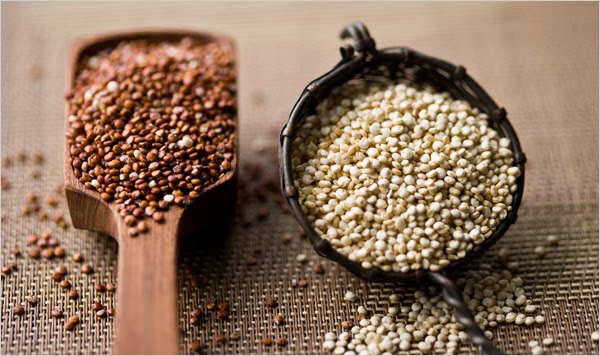
Quinoa (Chenopodium quinoa)(Image from NYTimes <-- click for recipes! I think you'll love this grain it's light and delicious!)
Quinoa (keen-wah) comes to us from the Andes, where it has long been cultivated by the Inca. Botanically a relative of swiss chard and beets rather than a “true” grain, quinoa cooks in about 10-12 minutes, creating a light, fluffy side dish. It can also be incorporated into soups, salads and baked goods. Commercially, quinoa is now appearing in cereal flakes and other processed foods. Though much of our quinoa is still imported from South America, farmers in high-altitude areas near the Rockies are also beginning to cultivate quinoa.

Quinoa is a small, light-colored round grain, similar in appearance to sesame seeds. But quinoa is also available in other colors, including red, purple and black. Most quinoa must be rinsed before cooking, to remove the bitter residue of saponins, a plant-defense that wards off insects. Botanists are now developing saponin-free strains of quinoa, to eliminate this minor annoyance to the enjoyment of quinoa.
Quinoa is the Grain of the Month in March. Learn more about quinoa.

Health bonus: The abundant protein in quinoa is complete protein, which means that it contains all the essential amino acids our bodies can’t make on their own.

Oats (Avena sativa)

Ah oatmeal, remember when mom made you a bowl of piping hot oatmeal on a cold winter day... wasn't it the best!?? Time to rekindle that love!(image from Sherman Heart and Vascular Blog)
Oats have a sweet flavor that makes them a favorite for breakfast cereals. Unique among grains, oats almost never have their bran and germ removed in processing. So if you see oats or oat flour on the label, relax: you're virtually guaranteed to be getting whole grain.

In the U.S., most oats are steamed and flattened to produce "old-fashioned" or regular oats, quick oats, and instant oats. The more oats are flattened and steamed, the quicker they cook – and the softer they become. If you prefer a chewier, nuttier texture, consider steel-cut oats, also sometimes called Irish or Scottish oats. Steel-cut oats consist of the entire oat kernel (similar in look to a grain of rice), sliced once or twice into smaller pieces to help water penetrate and cook the grain. Cooked for about 20 minutes, steel-cut oats create a breakfast porridge that delights many people who didn't realize they love oatmeal!
Oats are the Grain of the Month in January. Click here for more information on oats.
Health bonus: Scientific studies have concluded that like barley, oats contain a special kind of fiber called beta-glucan found to be especially effective in lowering cholesterol. Recent research reports indicate that oats also have a unique antioxidant, avenanthramides, that helps protect blood vessels from the damaging effects of LDL cholesterol.


Bulgur (Triticum ssp.)

(image from fat free vegan kitchen go to their site for the recipe)
When wheat kernels are boiled, dried, cracked, then sorted by size, the result is bulgur. This wheat product is sometimes referred to as “Middle Eastern pasta” for its versatility as a base for all sorts of dishes. Bulgur is most often made from durum wheat, but in fact almost any wheat, hard or soft, red or white, can be made into bulgur.

Because bulgur has been precooked and dried, it needs to be boiled for only about 10 minutes to be ready to eat – about the same time as dry pasta. This makes bulgur an extremely nutritious fast food for quick side dishes, pilafs or salads. Perhaps bulgur’s best-known traditional use is in the minty grain and vegetable salad known as tabbouleh.

Health bonus: Bulgur has more fiber than quinoa, oats, millet, buckwheat or corn. Its quick cooking time and mild flavor make it ideal for those new to whole grain cooking.
Read more about whole grains a to z on the whole grain council website! (The link is also added to my side bar for future use :))

I hope you ladies found this post informative, don't be afraid to introduce a new tasty grain to your dinner table!! Or start out small and switch out that white bread for some whole grain wheat bread... you'll be glad you did! There's so much more flavor (try whole grain bread french toast with the family for breakfast one morning... omg mouthwatering! and so much more filling.)

Friday, April 2, 2010

My New Diet...

Well it's official. I'm 17 again...
 I'll just come right out and say it...

I GOT BRACES!


Nerd Alert!


I went back to work after having them put on and one of my co-workers made fun of my voice... another asked me if I was invited to prom yet. Yep all the stereotypes are true, you spit, you slurp, and you spit and slurp while talking. I don't think I could have survived this in high school. I'm having a hard enough time a decade later. I gotta give props to all the teens who have these, cause these bitches HURT. I feel like I've been punched in the mouth.

I've been 17 again for only 3 days now... and food has not been my friend. The act of chewing hurts, and everyone at the dentist office says I should just enjoy some ice cream for the pain.

WHAT!!! NO. I can't develop an ice cream addiction for the next 14 months. Yep, 14-16 months of treatment time.... I'll be 17 for a while.

So basically my new diet consists of soft foods, oatmeal, yogurt, soups, eggs, pasta and rice. Chewing bread and chicken is pretty much unbearable right now even in super tiny tiny peices, but I've been told that it will get better. But even after it gets better I'm still restricted from eating certain foods...

No bagels or Pizza crust... which I understand now because it hurts to freakin' chew them! But Pizza is a weakness of mine so this will be a way for me to avoid it.

No sticky foods... that means no more sneaking a mini snickers bar from the office supply closet!

No popcorn... this breaks my heart! I was looking forward to enjoying a small bag of popcorn at the eclipse midnight show as a cheat treat... and now I'm denied!! NO POPCORN?!? CRIES!!!

No sugary drinks... No problem here... I rarely if ever drink soda or fruit juices. I'm a sparkling water gal.

No Hard Food... No carrots no apples, no corn on the cob! This makes me sad too, I love these foods, I can still eat them but they must be cut, sliced or taken off the cob. BOO!

So basically right now I've been surviving off of soft foods, and water. No snacks! This is one thing I'm happy about. I'm not snacking... on anything! I think because my mouth is so sore I don't even think about food, and also keeping these things clean are a pain in the ass...so if I'm going to eat I'm having a full meal! I hope this newly restricted diet helps me lose even more weight!

The only other downfall I've noticed is that I can't chew gum... and I thought oh well duh no big deal I'll just have mints handy...but I didn't think about what to do when it came to running. I chew gum when I run to help keep my mouth from drying out and I ran 5 miles yesterday and I really wished I had gum to chew on...but ok possibly TMI right now, you salivate a lot with these things in your mouth so it wasn't too much of a problem it was just... ew! Going to have to figure out what other runners with braces do for this problem.

So that's my new diet. :)


p.s. I graduated to salad for lunch today...however it took me forever to eat it and I had to have it in very small pieces and mostly only ate the leafy parts.... baby steps!

Monday, March 8, 2010

Vitamins and Minerals: A Clueless Gal's Attempt at Research

Blog reader ThatPastryGirl aka Karin asked me on twitter: Are there any supplements you think are essential? Ie multivitamin etc?


Once again Team Six Pack works hard at answering your questions....

This was a topic I definitely needed to research, because honestly I'm not too familiar with them myself and probably lacking in many of them. There are a lot of books out there on the topic as well and I'm sure most are very accurate and complete, but there's a lot to search through. I sat at borders for a good hour debating on which book to purchase: "A Complete Idiots Guide to Vitamins and Minerals" because honestly I am a complete idiot on this topic ;), this one had the most recent publication date, but I've noticed the "idiots and dummy's" books tend to dumb down their language and I definitely wanted a book that was thorough on this topic so I could learn as much as possible. Other books I looked at were "Vitamins, Herbs, Minerals & Supplements: The Complete Guide" by H. Winter Griffith, M.D., clocking in at 504 pages long, and "The New Encyclopedia of Vitamins, Minerals, Supplements & Herbs: A completely cross-referenced user's guide for optimal health" by Nicola Reavley clocking in at 792 pages long....

OY!! Information OVERLOAD


For the purposes of this article though, I am going to only discuss essential Vitamins, Minerals for a healthy diet, weight loss, exercise, and the use of some vitamins and supplements for women's needs... such as PMS... lets face it ladies a lot of us suffer from it and it's just a fact of life that I am bitchier certain times of the month than others, last week was a perfect example.

So after debating the merits of each book, reading the introductions searching the indexes etc., I settled on the Encyclopedia because it was the most thorough. However dear readers, as always please consult your physicians if you think you need to start taking vitamins or supplements. I am not a Doctor, dietitian or nutritionist I'm simply trying to learn all that I can about nutrition and health, if you take away anything from this article perhaps it's just list of questions to ask your Dr....because I know I'll have lots of questions for mine. :)


Ok, let's get this party started...

What's a Vitamin!??

Vitamins are substances which, in small amounts, are necessary to sustain life. They must be obtained from food as they are either not made in the body at all, or are not made in sufficient quantities for growth, vitality or wellbeing. Lack of a particular vitamin can lead to incomplete metabolism, fatigue and other health problems; and in severe cases, to deficiency disease.

What do vitamins do?
Individual vitamins have specific functions which vary widely and can overlap. They are involved in growth, the ability to produce healthy offspring, and the maintenance of health. They play a role in metabolism, enabling your body to use other essential nutrients such as carbohydrates, fats, proteins and minerals. Vitamins are important for a normal appetite, in digestions, mental alertness, and resistance to bacterial infections.

How Many Vitamins are there?
In the USA the following are officially listed as vitamins: vitamin A, C, D, E, K and the B vitamin complex containing: B1 (thiamine), B2 (riboflavin), B3 (niacin), B6 (pyridoxine), folic acid, B12 (cobalmin), biotin and pantothenic acid.

Vitamins are generally divided into two categories: fat soluble and water soluble. Vitamins A, D, E, and K are fat soluble, they require an adequate supply of minerals and fats to be absorbed in the digestive system and are stored in the liver. The remaining vitamins are water soluble with any excess being excreted in the urine. These need to be replenished frequently.
Break Down! (I am not going to list any of the recommended dosages in the book, I feel that is something that should be discussed with your doctor.)

...Vitamin A...

Essential for:
Healthy eyes and vision
growth, repair and cell differentiation
health of epithelial cells
protection against infection
a healthy reproductive system

Therapeutic uses of supplements:
Supplements are used to boost immunity; prevent cancer; treat skin disorders such as acne and psoriasis; and treat eye problems.

Sources:
cod liver oil, carrots (raw), squash, kale (boiled), mango (raw), canteloupe, apricots, sardines, tomato sauce, bran, pumpkin (peeled & boiled), broccoli, sweet potatoes (peeled, boiled), green peppers (raw), milk, cream cheese.

...Vitamin B Complex...

Essential for:
Releasing energy from food
carbohydrate and fatty acid metabolism
healthy growth
healthy skin, blood, hair and muscles
a healthy brain and nervous system
alcohol metabolism

Absorption and metabolism:
Daily intake is necessary.

Deficiency:
Symptoms include fatigue, depression, reduced mental functioning, muscle cramps, nausea, heart enlargement and eventually beriberi, which can cause paralysis.

Thereaputic uses of supplements:
Thiamin supplements have been used to improve mental function in alcoholics and the eldery. They mage be useful in times of street and have also been used to treat fatigue, irritability, depression, to aid digestion, and to promote healing.

Sources:
Thiamin Pork, oats, wheatgerm, peacans, pistachios, bra, green peas, kidney beans, brazil nuts, ham, liver, chickpeas (cooked), cod, cashews, whole grain bread, beef steak.

Riboflivin almonds, pink salmon, bran, spinach, milk, veal, wheatgerm, eggs (boiled), feta cheese, oats, soy milk, pork, cheddar cheese.

Niacin tuna (canned), special K cereal, bran, swordfish, veal, peanuts, trout, chicken breast (roasted), mackerel, beef (lean), wheatgerm, pork, corn.

...Vitamin B6...

Essential for:
the release of energy from food
healthy cardiovascular, nervous and immune systems
protein metabolism and hormone production
healthy skin, hair and red blood cells
manufacture of genetic material of the cell
the conversion of tryptophan to niacin

Absorption and metabolism
Daily intake is necessary.

Deficiency:
Symptoms include weakness, poor appetite, dermatitis, a sore mouth, susceptibility to infection, and eventually convulsions and anemia. Deficiency may play a fole in heart disease, kidney stone formation, carpal tunnel syndrome and depression.

Theraputic uses of supplements:
These include asthma, cardiovascular disease, mood disorders, PMS, stress, carpal tunnel syndrome, fatigue, nausea of pregnancy, skin problems and kidney stones.

Sources:
wheatgerm, wheatbran, bananas, chicken, avacado, ham, tuna (canned in water), spinach (cooked), soybeans (cooked), rasins, beef (serloin grilled), green peas (cooked), pork chop (grilled), salmon, brown rice, peanuts, potato (baked), brussel sprouts.

...Vitamin C...
Essential for:
the manufacture of collegen, a protein which forms the basis of connective tissues such as bones, teeth and cartilage
wound healing
healthy immune and nervous systems
adrenal hormone production
as an antioxidant to help prevent disease

Absorption and metabolism:
Daily intake is necessary.

Deficiency:
Sever deficiency leads to scurvvy with symptoms of bleeding gums, joint pain, easy bruising, dry ski, fluid retention and depression. Marginal deficiencies may play a role in the development of cancer, cardiovascular disease, high blood pressure, lowered immunity, diabetes and cataracts.

Theraputic uses of supplements:
These include the treatment and prevention of many disorders including cardiovascular disease, high blood pressure, cancer, gallstones, cataracts, diabetes, asthma and infections.

Sources:
blackcurrants, red pepper (raw), guavas, oranges, grapefruits, papaya, lemons, strawberries, green pepper, kiwi fruit, cantaloupe, broccoli (boiled), mangoes, kale, brussel sprouts (boiled), honeydew melon, raspberries, cauliflower, tangerines, pineapples, cabbage.

...Vitamin D...

Essential for:
the absorbtion and use of calcium and phosphorus, which are vital for function such as the development of bones and teeth
healthy regulation of some hormones
normal cell growth and maturation

Deficiency:
deficiency in children leads to rickets in which bones lose calcium and become soft and curved. In adults, symptoms include bone pain and tenderness, and muscles weakness. Deficiency may also increase the risk of osteoporosis, arthritis and cancer.

Thereapeutic uses of supplements:
Supplements have been used to treat osteoporosis and osteoarthritis in elderly people. Synthetic vitamin D analougues are used to treat psoriasis.

Sources:
Medicinal cod liver oil, salmon, tuna, whole milk (fortified), skim milk (fortified), sardines, shrimp, bran, corn flakes, special K cereal, egg yolk.

...Vitamin E...

Essential for:
action as an antioxidant to provide protection for cells against free radical damage which may lead to disorders such as heart disease and cancer. It is particularly important in protecting fats, cell membranes, DNA and enzymes against damage.

Deficiency is rare.

Therapeutic use of supplements
Supplements have been used to treat and prevent many disorders including heart disease, cancer, cataracts, diabetes, asthma, Alzheimer's disease and infertility.

Sources:
wheatgerm, sunflower seeds, hazelnuts, peanuts, soy beans (cooked), safflower oil, canola oil, corn oil, avacado, spinach (cooked), tomato sauce, olive oil, broccoli, grapes, blackberries, parsnip (cooked), peaches, brussel sprouts (cooked), tomatoes, eggs.

...Vitamin K...
Essential for:
blood clotting
bone metabolism
kidney function

Deficiency in adults is rare.

Theraputic uses of supplements:
Vitamin K supplements are used to prevent hemorrhages and may be useful in the treatment of osteoporosis.

Sources:
broccoli (cooked), spinach (raw), avocado, lettuce, cabbage (raw), watercress (raw), snap beans (raw), plums, canola oil, kiwi fruit, greens peas (cooked), miso, carrots (cooked), sweet peppers, potato with skin, tomatoes, celery (raw), peanut butter, olive oil, cauliflower (boiled), cucumbers (raw).


Time to learn about Minerals!!!


What are minerals?
Minerals are naturally occuring inorganic (non carbon containing) elements which play a part in many biochemical and physiological processes necessary for body maintenance. They are important structural components of several body tissues; for example calcium, phosphorus and magnesium make up an important part of bone tissue. Minerals are as important as vitamins for your body to function properly.

The body cannot make any minerals, they must be obtained from plant and animals foods, and water, which may contain dissolved minerals.

Which are the essential minerals?
About 20 minerals are known to be mecessary for body maintenance and regulatory functions. The major minerals are calcium, phosphorus, potassium, sodium, cloride, magnesium and sulfur.

I will only discuss the major minerals that I read were healthy for the heart and for metabolism for the purposes of this entry. Time to break it down...!

...Calcium...

essential for healthy bones and teeth, muscle contraction, a healthy heart and nervous system, blood pressure regulation and clotting.

Deficiency leads to nerve and bone disorders, osteoporosis, high blood pressure, pre-eclampsia of pregnancy and may contribute to colon cancer.

Sources: Milk, cheddar cheese, salmon, crab, figs, peanuts, baked beans, brazil nuts, kale, walnuts, almonds, broccoli (cooked).

...Copper...

Essential for normal metabolism, healthy bones, joints, skin and blood vessals, healthy cardiovascular system.

Deficiency leads to anemia, connective tissue defects, immune suppression, nerve problems and heart disease

Sources: seafood, meat and whole grains, lentils, mushrooms, spinach (cooked), almonds, avocado, tofu.

...Potassium...

Essential for water balance in the body, muscle contraction, energy metabolism, protein and carbohydrate metabolism a healthy heart and blood vessels.

Deficiency may lead to increased risk of high blood pressure.

Sources: fruits, vegetables and whole grains.

...Sodium...

Ahh... salt, yup it's a mineral, this one we hear a lot about how in excess it's bad for you...here's what the book has to say!

Essential for water balance in the body, muscle contraction, energy production, stomach acid production

Sources: Foods high in sodium include processed meats, cheese, margarine and butter. (essentially foods that aren't that good for you!)

Effects of excess intake: High blood pressure, PMS, and possibly osteoporosis, asthma and urinary stones

Supplementation is usually unnecessary!


...Iron...

Essential for oxygen transport and storage in the blood and muscles, fatty acid metabolism, energy production, maintenance of a healthy immune system.

Deficiency leads to weakness, fatigue, reduced resistance to infection and eventually anemia

Sources: meat, whole grains and dark green leafy vegetables.

...Magnesium...
Essential for production and transfer of energy a healthy heart bones, muscles and blood vessels, protein and carbohydrate metabolism

Deficiency symptoms include fatigue, mental and heart problems.

Sources include whole grains, nuts and green vegetables.

Supplementation includes treatment of stress, fatigue, cardiovascular disease, migrane, kidney stones, asthma, PMS, muscle cramps, pre-eclampsia and diabetes.

...Phosphorus...

Essential for healthy bones, metabolism of proteins, carbohydrate, fats and DNA, energy production and exchange.

Deficiency symptoms are rare.

Sources include meat, wheatgerm, poultry, cheese, milk, canned fish, nuts and whole grain cereal.

...Zinc...

Essential for energy production healthy immune and reproductive systems, normal growth and development, healthy brain, teeth, bones and skin.

Deficienct includes skin problems, fetal abnormalities, reproductive defects, cardiovascular disease, immuse deficiency, loss of eye function and osteoporosis.

Sources include seafood, meat and whole grains.

Supplements are often given to diabetics and pregnant women.

*takes deep breath* not joking I literally just let out a BIG exhale, haha. I know it's a lot to absorb! Now it's time to analyze all this information!


Are Supplements Even Necessary??
Whether or not vitamin and mineral supplements are necessary is the most controversial topic in nutrition. The question a need for supplements is central to the debate about the levels of vitamins and minerals required to promote optimal health. Given that people vary so much in their requirements and that very few people eat really well-balanced diets, vitamin and mineral supplements can be viewed as a relatively inexpensive form of "nutritional insurance."

Who might need them??Supplements may be beneficial for those on weight loss diets. Many people, particularly women, eat low calorie diets which are inadequate in iron, calcium and zinc.
Strict vegetarians who avoid meat and dairy products must obtain vitamin B12 from supplements.

I have posted previously about nutrition and exercise, in my post food to fuel your work outs here's some information about Vitamins, minerals and exercise:


Vitamin C: May be beneficial for those who exercise heavily and have problems with frequent upper respiratory tract infections.

Vitamin E: there is some evidence that vitamin E may decrease muscle fatigue and improve endurance performance

B Vitamins: are essential for the conversion of carbohydrates to energy, and as to calorie and carbohydrate intakes increase, the requirement for B vitamins also increases.

Vitamin B6: Exercisers and athletes often have low vitamin B6 levels.

Calcium: female athletes often have menstrual irregularities, which are due to disruption of the normal estrogen cycle. Lack of estrogen can lead to a loss of bone mineral density.

Iron: Heavy exercise may lead to iron deficiency. Distance runners are at particular risk as running appears to lead to a decrease in body stores of iron.

Magnesium: Strenuous exercise alters magnesium concentrations in muscle and blood. Stressful conditions such as intense training and competition may also increase the need for magnesium.

Zinc: Athletes can be deficient in zinc as increased needs and increased sweating and urinary excretion may lead to greater requirements.


Weight loss! I thought this particular passage of the book was very important and touched on exactly what type of diet worked for me and what I promote here on this blog:


Despite the availability of low fat foods and increasing awareness of the risks, obesity is still on the increase. However, despite the prevalence of obesity, many people do not consume enough essential nutrients to keep themselves healthy, and overweight and poor nutrition are major risk factors for some of the most common diseases in our society. These include high cholesterol levels, atherosclerosis, hypertension, heart disease, diabetes...

Hand in hand with the increase of obesity has come a national obsession with weight loss. Many overweight people are drawn to fad diets that promise fast results with minimal effort, only to see the weight go back on just as quickly once they return to their regular diet. Such a pattern of repeated weight loss and gain may contribute to lifelong obesity. The only way to lose weight and keep it off is to develop, and stick to a healthy, nutrient dense, balanced diet and a regular exercise program.


Vitamins and Minerals to help during weight loss:

B Vitamins: are essential for the metabolism of food and optimal intake is necessary to ensure that this takes place effectively.

Minerals: extra minerals may also be useful in preventing deficiency, especially in people whose fiber intakes are high, as fiber reduces the absorption of calcium, iron, zinc, and copper.

Antioxidants: Since weight loss usually involves a mild process of detoxification, with the body burning fat and sometimes other tissues, antioxidants may be useful. These include beta carotene, vitamin C, vitamin E and selenium.


Ok, that's all for now! Please feel free to ask more questions, or pick up your own copy of "The New Encyclopedia of Vitamins, Minerals, Supplements and Herbs" by Nicola Reavley for more information. It's VERY informative and my copy is already bookmarked, dogeared and has a damaged spine :).

And again, I stress... please discuss with your doctor before taking any of these supplements...proper nutrition might be all your lacking instead of taking a multivitamin, but that is for them to decide.